Does Decaf Coffee Dehydrate You? A Scientific Guide to Decaf and Hydration
At Bazan Coffee, we believe every cup-caffeinated or not-should contribute to well-being and enjoyment. But there’s a lingering question among coffee lovers who choose to go low-caffeine: Does decaf coffee dehydrate you?
With growing interest in health-conscious coffee choices, understanding how decaf interacts with hydration is essential. In this guide, you will explore whether your soothing cup of decaf is working against your hydration goals.
Let’s unpack the facts with clarity and precision.
The Popularity of Decaf-and the Hydration Concern
Decaf coffee has earned its place among specialty drinkers, offering flavor and ritual without the stimulant effects of caffeine. But despite its benefits, it often carries a questionable reputation as a possible diuretic-meaning, it might promote fluid loss and cause dehydration.
The concern largely stems from confusion around caffeine and its impact on the body’s fluid balance. Since decaf still contains trace amounts of caffeine, many wonder: Is that enough to make a difference?
Spoiler: Scientific evidence shows that decaf coffee does not dehydrate you. But there are nuances to understand.
What Makes a Beverage Dehydrating?
To determine whether a drink dehydrates the body, researchers look at its net fluid balance-how much fluid it provides versus how much it stimulates loss (primarily through urination).
Beverages are considered dehydrating if they act as diuretics without offering enough fluid to offset the loss. For instance, strong alcohol or excessive doses of caffeine can have this effect. But everyday beverages like tea and coffee-especially in moderate amounts-rarely cause significant fluid imbalance.

Understanding Caffeine’s Diuretic Effect
Caffeine is a mild diuretic, especially in doses above 300 mg per day. Caffeine promotes the dilation of blood vessels in the kidneys, increasing filtration and, in turn, urination.
However, most studies conclude that:
-
The diuretic effect of caffeine is mild.
-
It is tolerance-dependent, meaning regular consumers feel it less.
-
It is dose-sensitive, meaning lower doses (like those in decaf) have almost no measurable effect.
Conclusion: The small amount of caffeine in decaf coffee (typically 2–15 mg per cup) is far below the threshold where diuretic effects are seen.
Does Decaf Coffee Hydrate or Dehydrate?
Let’s examine the hydration contribution of decaf more clearly.
1. Water Content
Coffee-regular or decaf-is made of 98–99% water. That means nearly every cup provides fluid that contributes to your daily hydration.
2. Research Findings
A 2014 study published in the American Journal of Clinical Nutrition found no significant difference in hydration levels between participants who consumed water and those who consumed moderate amounts of coffee.
Caffeine intake up to 400 mg/day does not increase total urine output when beverages are consumed in standard quantities.
Decaf coffee, with its minimal caffeine, behaves almost identically to water in terms of fluid balance.
Who Might Be Sensitive?
While decaf is hydrating for most people, there are specific groups who might need to be cautious:
-
People with kidney disorders, who may need to regulate fluid intake carefully.
-
Individuals on diuretic medication, where all fluid balance should be discussed with a physician.
-
Those extremely sensitive to caffeine, even in small amounts.
That said, these are special cases-not the norm.

Frequently Asked Questions
Does decaf coffee count toward daily water intake?
Yes. For most people, decaf coffee contributes positively toward your total daily fluid intake. Its high water content makes it hydrating.
Does caffeine-free coffee exist?
Yes. Some products are labeled “caffeine-free,” often herbal coffee substitutes. However, almost all true decaf coffees still contain a small amount of caffeine.
How much decaf is safe to drink per day?
There’s no universal limit, but most experts agree that up to 3–4 cups per day of decaf is perfectly safe and hydrating for healthy adults.
Can I drink decaf instead of water?
While decaf helps hydrate, it shouldn’t entirely replace water in your diet. Ideally, use decaf as a supplement to your hydration routine-not a substitute.
Summary Table: Caffeine, Hydration, and Decaf
|
Beverage Type |
Average Caffeine (per 8 oz) |
Hydrating Effect |
Diuretic Risk |
|
Water |
0 mg |
Very high |
None |
|
Decaf Coffee |
2–15 mg |
High |
Very low |
|
Regular Coffee |
95–200 mg |
Moderate–high |
Mild (above 300mg/day) |
|
Energy Drinks |
70–150 mg |
Moderate |
Medium |
|
Black Tea |
30–60 mg |
High |
Low |
Does Decaf Coffee Dehydrate You?
No. Decaf coffee does not dehydrate you. On the contrary, it provides fluid and can absolutely be part of a healthy hydration strategy. With virtually no diuretic effect at typical consumption levels, you can enjoy your cup with confidence.
For coffee that’s clean, balanced, and made with intention-turn to Bazan.
Explore Bazan’s premium options today and experience hydration without compromise. Choose quality. Choose comfort. Choose Bazan Coffee.
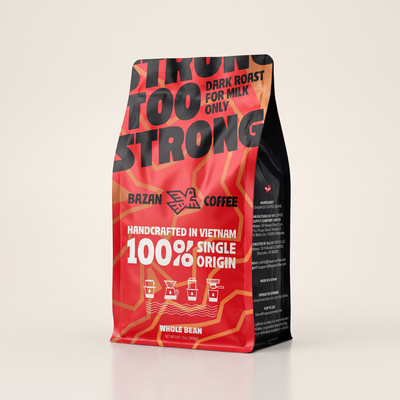
Brew It with Too Strong: Vietnam’s Bold Robusta
Too Strong is 100% Vietnamese Robusta from Đắk Lắk, dark roasted to stand up to milk and ice. It carries roughly twice the caffeine of a typical arabica blend (about 2.2–2.7%), with notes of chocolate, caramel and warm toast and none of the burnt, bitter bite.
- Made for milk: built for cà phê sữa đá, lattes and iced coffee.
- Brew it your way: phin filter, espresso machine, French press or paper filter.
- Fresh from the farm: roasted date printed on every bag.