The History of Coffee: From Ancient Discovery to Global Phenomenon
Coffee is one of the most beloved beverages worldwide, with a rich history spanning centuries, continents, and cultures. From its legendary discovery in Ethiopia to becoming the second most traded commodity in the world, coffee has played a vital role in shaping economies, social interactions, and even political movements.
In this guide, we will explore the history of coffee, tracing its origins, expansion, and influence across civilizations. Whether you are a casual coffee drinker or a dedicated enthusiast, understanding the history of coffee timeline will deepen your appreciation for this iconic beverage.
The Legendary Discovery: Coffee’s Ethiopian Origins
The history of coffee is often traced back to Ethiopia, where legend attributes its discovery to a goat herder named Kaldi in the 9th century.
The Story of Kaldi and His Dancing Goats
According to legend, Kaldi noticed that his goats became unusually energetic after eating red cherries from a certain tree. Observing their excitement, he tried the berries himself and experienced a surge of energy. Excited by his discovery, Kaldi brought the cherries to a local monastery, where a monk disapproved and threw them into the fire. The roasted beans produced an enticing aroma, leading monks to experiment with brewing the beans into a drink that helped them stay awake during long prayers.

While the legend of Kaldi may be more folklore than fact, historical evidence suggests that coffee consumption began in Ethiopia, where local tribes ground coffee beans and mixed them with animal fat to create an early form of an energy bar.
The Spread of Coffee to the Arabian Peninsula
By the 15th century, coffee had reached the Arabian Peninsula, where it became deeply embedded in Middle Eastern culture. Yemen played a critical role in cultivating and trading coffee, particularly in the port city of Mocha, which would later lend its name to a famous coffee-chocolate beverage.

Coffee in the Islamic World
Sufi monks in Yemen used coffee to stay awake during nighttime prayers, and its stimulating effects led to its widespread adoption in religious and academic circles. Coffeehouses, known as qahveh khaneh, emerged in cities such as Mecca, Cairo, and Istanbul. These coffeehouses became social hubs for intellectual discussions, music, and storytelling.

The coffee trade remained under tight Yemeni control for centuries. However, coffee’s popularity soon outgrew the region, leading to its spread across Europe and Asia.
Coffee Reaches Europe and the Birth of the Coffeehouse Culture
Coffee first arrived in Europe in the 16th century, brought by Venetian traders who had encountered it in the Ottoman Empire. By the 17th century, coffeehouses began to flourish in major European cities like Venice, London, and Paris.
The Rise of European Coffeehouses
-
Venice (1615) – The first recorded importation of coffee into Europe.
-
London (1652) – The opening of England’s first coffeehouse.
-
Paris (1672) – France’s first coffeehouse appears, inspiring widespread coffee consumption.
Coffeehouses in London were nicknamed "penny universities", as visitors could engage in stimulating discussions for the price of a cup of coffee. Many famous institutions, including Lloyd’s of London, originated in coffeehouses.

Despite initial resistance—some religious leaders called coffee the "bitter invention of Satan"—Pope Clement VIII tasted coffee and declared it delicious, further cementing its place in European culture.
The Coffee Plantations and the Global Coffee Boom
As European powers expanded their colonies, they sought to control coffee production. The Dutch were among the first to cultivate coffee outside of Arabia, planting it in Java, Indonesia, in the 17th century. This was the beginning of global coffee cultivation.
Major Coffee-Producing Regions Emerge
-
Indonesia (1699) – The Dutch establish coffee plantations in Java.
-
Caribbean & South America (18th century) – French and Spanish colonists introduce coffee to Haiti, the Dominican Republic, and Cuba.
-
Brazil (1727) – Coffee production begins, eventually making Brazil the world’s largest coffee producer.
The rise of large-scale plantations led to increased coffee availability but also came with ethical concerns, as much of the early labor was done by enslaved people in the colonies.
The Industrial Revolution and Modern Coffee Culture
By the 19th and 20th centuries, coffee had become a household staple worldwide. Several key innovations shaped modern coffee consumption:
-
1901 – The first instant coffee is invented by Japanese scientist Satori Kato.
-
1908 – The paper coffee filter is patented by Melitta Bentz.
-
1933 – The Moka pot is invented by Alfonso Bialetti in Italy.
-
1946 – Achille Gaggia invents the first modern espresso machine.
The history of coffee timeline saw rapid innovation during the 20th century, from the rise of espresso culture in Italy to the emergence of specialty coffee movements in the U.S. and beyond.
The Third Wave Coffee Movement and Specialty Coffee
In recent decades, coffee has undergone a third-wave revolution, shifting from mass production to an emphasis on quality, sustainability, and direct trade. Today’s coffee drinkers seek ethically sourced, single-origin, and expertly roasted coffee.
Bazan Coffee is proud to be part of this movement, offering high-quality, specialty Vietnamese coffee, including Fine Robusta – Krong Nang and Specialty Arabica – Cau Dat.
Experience the Rich History of Coffee with Bazan Coffee
From Kaldi’s legendary goats to third-wave specialty coffee, the history of coffee is a journey of discovery, innovation, and cultural exchange. Each cup of coffee tells a story—of its origins, cultivation, and the passionate people behind it.
At Bazan Coffee, we understand that the key to enjoying authentic Vietnamese coffee starts with choosing only the finest beans. Whether you’re brewing at home or enjoying a traditional cup at your favorite café, the quality of the beans is paramount to capturing the true essence of Vietnamese coffee. With Bazan’s premium, specialty-grade beans, you'll enjoy a rich, bold, and smooth cup that embodies the true spirit of Vietnam's coffee culture.
Brew It with Too Strong: Vietnam’s Bold Robusta
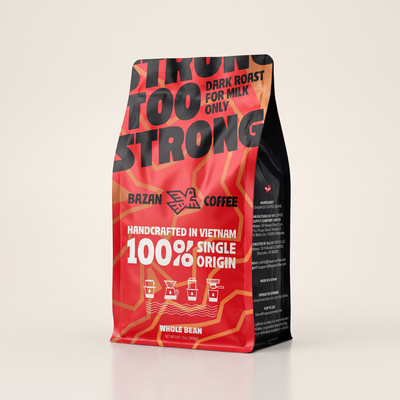
Too Strong is 100% Vietnamese Robusta from Đắk Lắk, dark roasted to stand up to milk and ice. It carries roughly twice the caffeine of a typical arabica blend (about 2.2–2.7%), with notes of chocolate, caramel and warm toast and none of the burnt, bitter bite.
- Made for milk: built for cà phê sữa đá, lattes and iced coffee.
- Brew it your way: phin filter, espresso machine, French press or paper filter.
- Fresh from the farm: roasted date printed on every bag.